
By Milagros Roulet
Special to the Daily Sun
Natural lighting
A tropical silver moon is always spectacular, but for eight years now it refuses to fully shine on an ecological community project in a rural area of San Juan, basically for shortage of funds and a slack in government attention. Community residents, under the mentorship of well-known San Juan architect Fernando Abruña, want to build the “Full Moon Park,” in a 23-acre wooded area of the Los Capuchinos sector in Río Piedras, but the dream remains locked into maps, renderings, plans and the hearts of its proponents.
“As conceived, it is a true community enterprise and with bona fide ecological accoutrements. The Capuchinos community has been pushing the project forward for eight years now without much advance,” said Abruña. The architect, a University of Puerto Rico professor, said the park began as an idea in 2001 and he got his students and community residents quickly involved in making it a reality. But then, the walls of bureaucracy began to fence the project in. Both then-governors Sila Calderón and Aníbal Acevedo Vilá never signed the executive order to fund the park’s construction. Incumbent Gov, Fortuño has not announced concrete plans for the project, nor has San Juan Mayor Jorge Santini.
The Commonwealth government did pay in 2004 some $10.4 million for the land before it was to be developed into a high-rise condo complex, with the Fortuño administration now finalizing the deal. Proponents estimate the project entails a $3.3 million initial investment. Costs could go up to $4.5 million, according to documents related to the park. Abruña proposes a park to enjoy the spectacle of a full moon in all its phases and splendor.
“We consider night light an eco-tourism attraction,” he stated. “But that’s just the recreational concept. The idea is to create a sustainable community venture, a green business model for other groups.”
Communal engagement is key
The community will manage and benefit from the park, explained architect Leyda Gómez, who is in charge of the Moon Park project at the Puerto Rico National Parks Company.
“The plan is to have control emplacements for ticket sales and community-owned stores that will sell souvenirs with an astronomical theme. This not only implies self-sustainability, but also respect for our planet, respect for Nature, respect for the environment,” said Gómez. “Full Moon Park will symbolize a bridge between suburban development, community involvement and environmental conservation.”
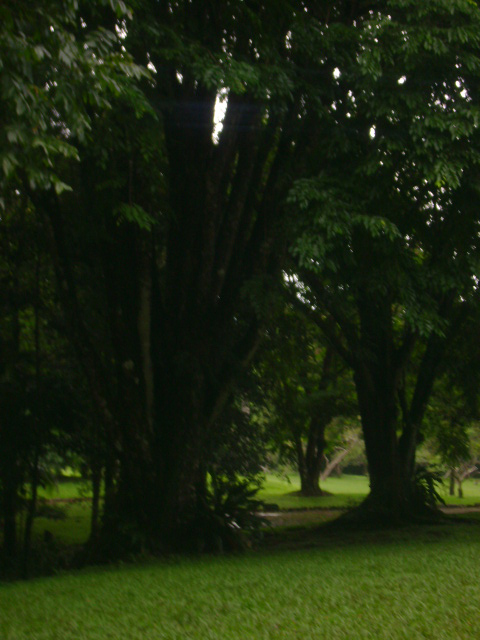
The park is conceived as a night observatory for the enjoyment of moonlight and will also have a “Moon Bridge” and an amphitheater for organized public events, all part of the San Juan Ecological Corridor plan, now under the aegis of the National Parks Company. Abruña has baptized the concept of moon light as a touristy attraction in a poetic way. He calls it “luminocturna.” The park amphitheater is dubbed “Selenita,” a venue for year-round recreational and cultural activities.
Abruña said there are some 12 total full moon days throughout the year that can become 36 when factoring in the day before and day after the peak illumination, not including overcast and rainy days. Moonlight will be projected to a 10-story high reflector disk, some 90 feet in diameter, specifically designed to beam the natural moon light on the amphitheater.
Green resourcing
Gómez indicated that all electricity used in Full Moon Park would come from natural sunlight, collected by photovoltaic cells. Rainwater will be made usable for bathing and drinking through treatment with ultraviolet rays. Waste will become compost for landscaping. Access to the park will be through non-motorized pathways for pedestrians and cyclists.
A Department of Transportation and Public Works official, Marta Bravo, explained that the agency has been working on a plan to reduce car use to get to the park, promoting instead commuter rail, the bus system and pedal power.
“We want to set up a functional intermodal access system for the park and then let people walk and enjoy,” Bravo said. “The network proposes a series of pedestrian trails to connect the Full Moon Park, the Río Piedras Botanical Gardens and the nearby Doña Inés Park.”
Gómez said the project meets all requirements under the “Leadership in Energy and Environmental Design,” a nonprofit international group that oversees environmentally friendly construction. It also has good marks from the U.S. Green Building Council.
Gómez attributed the delay in getting the unique park done to budget shortfalls. While some $1.5 million have been already allotted to Full Moon Park, much has been since invested in soil studies, design, and the plans. Only some $800,000 was left as of spring of this year but bidding for parts of the park have already begun. Abruña is optimistic about getting the project moving through federal American Recovery and Reinvestment Act (ARRA) funds.
“The project is shovel-ready. We have the land, the design, and permits. We just need more funds and lots of moonlight,” he concluded.


Leave a Reply